According to Prensky, what category do you fall into, and how has this affected your learning?
I'm a Digital Native. I enjoy being a Digital Native, and think it has served me well up to this point. I think there's probably levels to being a Digital Native -- Prensky wrote about this subject ~20 years ago now and the digital age has only continued to catapult itself into the future. I think that I'm probably one of the first generations of Digital Natives, born in 1997, right at the beginning of the .com boom and just as home PC's were about to enter the market is around the time that I was old enough to be capable of using them. I find myself today being shocked at what kids in elementary school can do with technology. So, while I'm certainly a Native and a lot of this digital era has come naturally to me and is still intuitive, I think there will be another shift. It won't just be Natives and Immigrants, technology is changing so much that kids today will now grow up with AI, Augmented Reality, Mixed Reality, and Virtual Reality devices -- I'm not native to that. I can still figure it out as I got and am confident in my capacity to understand technology, but I'm certain not to the degree that kids growing up today will be. There's levels to this.
https://pbs.twimg.com/media/EFasO_jX4AAFZt0.jpg:large
One of the myths Kirschner discusses is that being a 'digital native' doesn't necessarily mean one is 'digitally literate". What does he mean?
Being a Digital Native doesn't necessarily correlate to being able to effectively use, rather than consume, the digital language. Kirschner highlights, "while
students appear to use a large quantity and variety of technologies
for communication, learning, staying connected with their friends
and engaging with the world around them, they are using them
primarily for “personal empowerment and entertainment, but not
always digitally literate in using technology to support their
learning.". This is a core problem today -- technology has become to prevalent and integrated within our society, to the point where it's so easy to use and consume that you don't really have to know how or why it works, or how to make it work most efficiently for you. I think we're entering an interesting era of what's coming next and whether technology is being taken for granted by youth today.
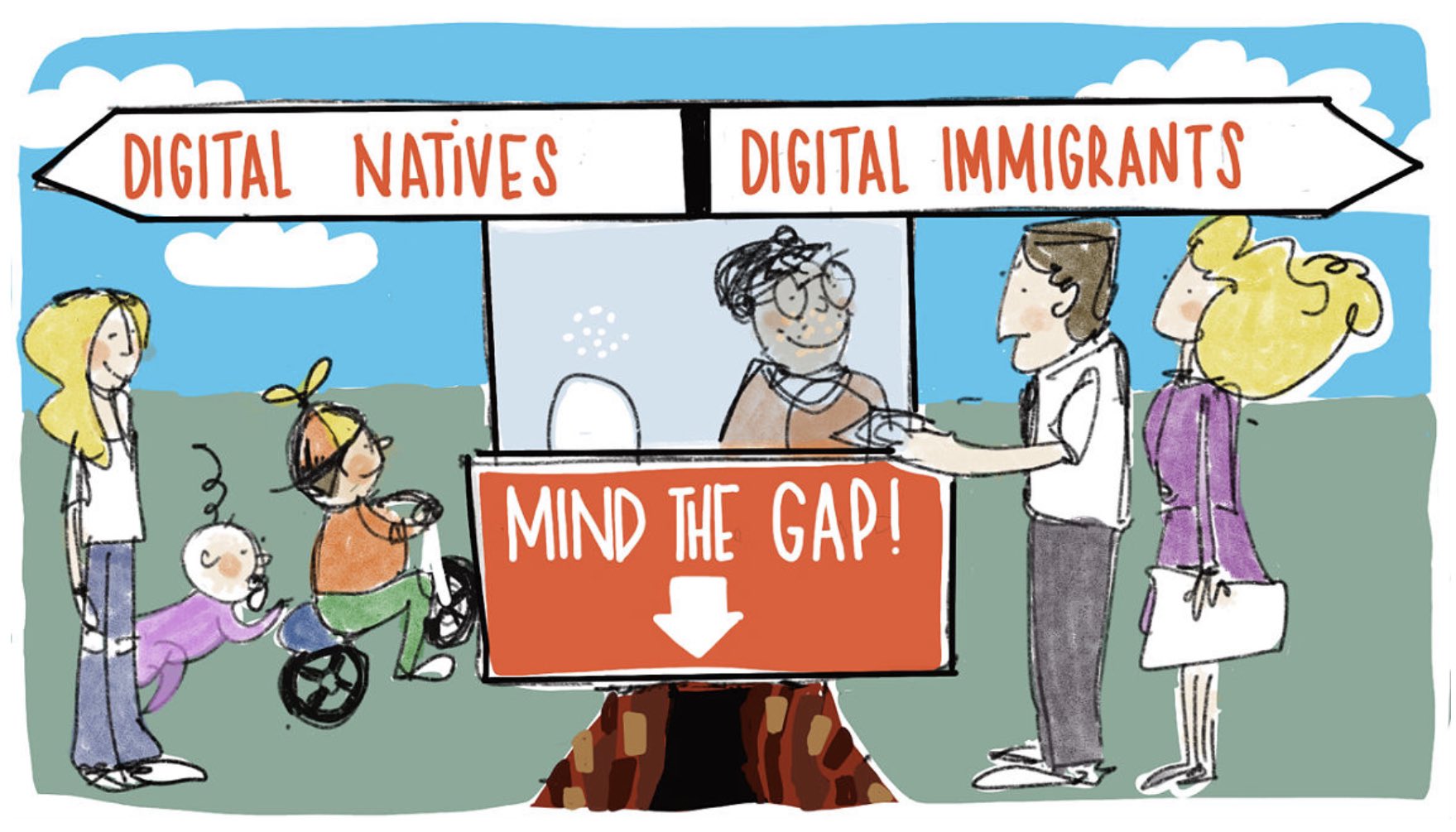
I thought the PBS cartoon was an interesting simplification in contrast to Prensky and Kirschner's work. I also really enjoyed this short TED talk that was done almost a decade ago by Sree Sreenivasan -- he gives an immigrants perspective on digital natives and immigrants.
https://www.youtube.com/watch?v=n_9gI0B4nS4
Sources:
Paul A. Kirschner, Pedro De Bruyckere, The myths of the digital native and the multitasker, Teaching and Teacher Education, Volume 67, 2017, Pages 135-142, https://doi.org/10.1016/j.tate.2017.06.001.
Comments
Post a Comment